
Choosing the right Ethernet cable for CCTV cameras is a key decision. Make it before you install an IP camera system. Cat5e and Cat6 are the two most common options. They look almost identical. But differences in speed, distance, and power handling can affect video quality for years. This guide breaks down both cable types so you can pick the right one for your home or business security setup.
What Are Cat5e and Cat6 Ethernet Cables?
Understanding Cat5e Ethernet Cable
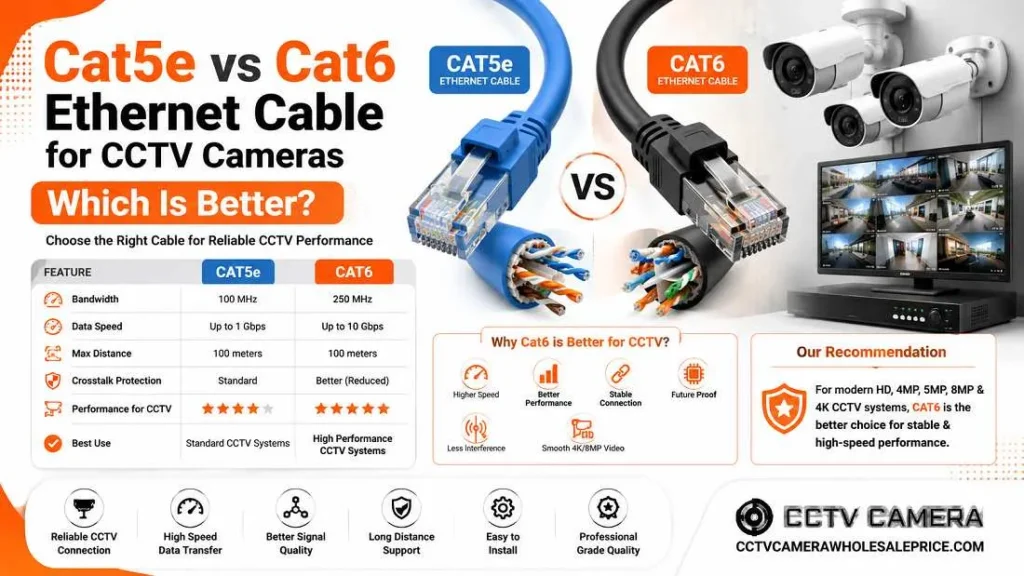
Cat5e (Category 5 Enhanced) is an entry-level, budget-friendly standard. It is still widely used in homes and small offices. It supports data transfer up to 1 Gbps. It runs at a 100 MHz bandwidth. It uses four twisted copper pairs without advanced shielding. This is enough for most standard IP camera setups.
Understanding Cat6 Ethernet Cable
- Cat6 doubles bandwidth to 250 MHz.
- It uses tighter wire twists and often a central spline separator.
These features reduce crosstalk. It still delivers 1 Gbps over the full 100-metre run. It can reach up to 10 Gbps over shorter distances, around 37–55 metres.
Cat5e vs Cat6 for CCTV Cameras
Speed and Bandwidth Comparison
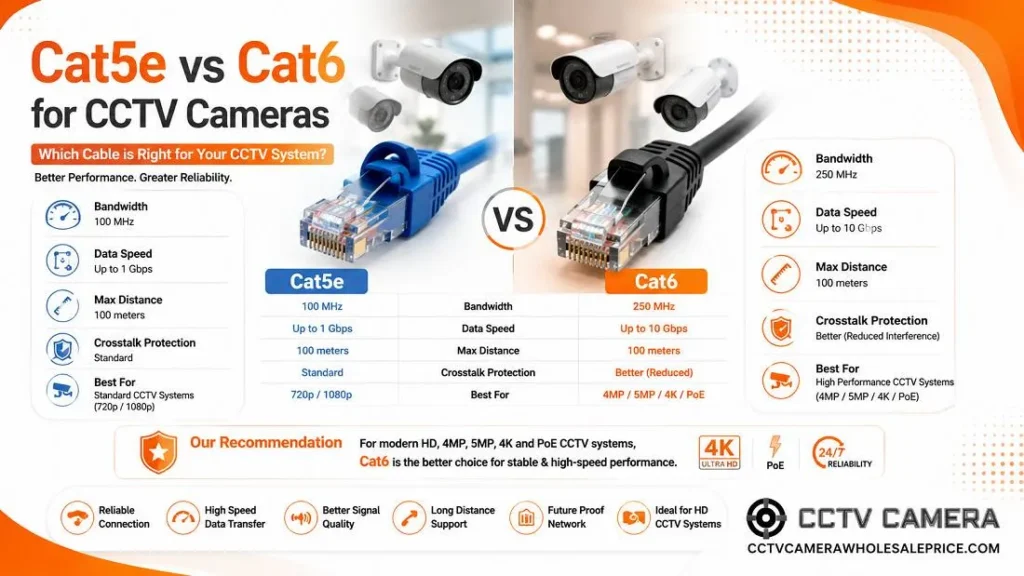
Both cables handle 1 Gbps with ease. This is much more than most IP cameras need. Most IP cameras use well under 100 Mbps of bandwidth. Cat6 has more bandwidth (250 MHz vs 100 MHz). This extra headroom mainly matters for high-density NVR systems with many cameras.
Maximum Cable Distance
Both Cat5e and Cat6 max out at 100 metres per run for standard Gigabit speeds. Cat6 only loses its edge if you push it toward 10 Gbps, where its effective range drops to roughly 55 metres.
Signal Quality and Interference Protection
Cat6 has tighter twists and optional shielding. It reduces crosstalk and electromagnetic interference better than Cat5e. This makes it more reliable in noisy places like industrial sites. It also works well near heavy machinery.
Cost and Installation Differences
Cat6 usually costs 10–30% more than Cat5e. It is a bit thicker, so it can be harder to pull through tight conduit. For most installers, though, the price gap is now small enough that it rarely changes the decision on its own.
Benefits of Using Cat6 for CCTV Systems
Better Performance for High-Resolution IP Cameras
For 4K, multi-sensor, or PTZ cameras with larger data streams, Cat6 provides more bandwidth. It also offers better resistance to noise. This helps keep footage smooth and consistent.
Improved PoE (Power over Ethernet) Support
Cat6 handles higher-power PoE standards more comfortably. IEEE 802.3at (PoE+) delivers up to 30W for PTZ cameras.
It supports motors and IR illuminators.
IEEE 802.3bt (PoE++) delivers 60–90W for advanced devices.
These devices often need more power.
Cat6 uses thicker 23 AWG conductors.
They dissipate heat better during sustained loads.
Future-Proof Network Infrastructure
If you plan to upgrade cameras, add analytics, or increase channels later, Cat6 gives you room to grow. You can expand without re-cabling your entire site.
When Is Cat5e the Better Choice?
Small Home CCTV Installations
For a small number of 1080p or entry-level 4K cameras at home, with short cable runs, Cat5e meets your needs. It also helps you avoid overspending.
Budget-Friendly Security Systems
If you are wiring many standard-definition or basic HD cameras and want to keep costs down, Cat5e is a solid choice.
How to Choose the Right Ethernet Cable for CCTV
Consider Camera Resolution and Number of Cameras
Higher megapixel counts and larger camera networks benefit from Cat6. It offers extra bandwidth headroom and better crosstalk control.
Indoor vs. Outdoor Cable Requirements
Outdoor runs need UV-rated, weatherproof jacketing in all cases. Indoor plenum spaces need plenum-rated cable for fire safety.
Choose Quality Connectors and Proper Installation
Always use pure copper conductors, not copper-clad aluminium, for PoE runs. Ensure connectors are terminated correctly to avoid voltage drop and signal loss.
Frequently Asked Questions (FAQs) – Cat5e vs Cat6 Ethernet Cable for CCTV Cameras
Is Cat6 better than Cat5e for CCTV cameras?
Cat6 offers more bandwidth and better resistance to interference. It is a stronger long-term choice. Cat5e is still adequate for smaller, budget-conscious installs.
Can Cat5e support 4MP or 8MP IP cameras?
Yes, in most cases. Typical IP camera streams use only a small part of Cat5e’s 1 Gbps capacity. Very high-resolution or multi-camera systems may benefit from Cat6.
What is the maximum distance for Cat5e and Cat6 cables?
Both are rated for 100 metres at standard Gigabit speeds. Cat6 can reach 10 Gbps, but only up to about 55 metres.
Which Ethernet cable is best for PoE CCTV systems?
Cat6 is often best for PoE+ and PoE++ cameras like PTZs. Its thicker wires carry steady power with less heat.
Conclusion
For small, budget-friendly home installations, Cat5e still gets the job done. For larger systems, high-resolution cameras, or PoE+/PoE++ PTZ units, Cat6 is a smart long-term choice. Whichever cable fits your project, cctvcamerawholesaleprice offers the best wholesale prices on Cat5e and Cat6 CCTV cabling. It also offers cameras and accessories. Call 999 970 4813 today to place your order and get expert guidance on the right cable for your setup.