
Wondering When Were CCTV Cameras Invented? The history of closed-circuit television (CCTV) spans over 80 years. It runs from World War II rocket launches to today’s AI-powered smart systems. These systems help protect homes and businesses. If you need reliable CCTV camera wholesale solutions, this guide can help. It explains the technology that protects your property. It can help you understand its value today.
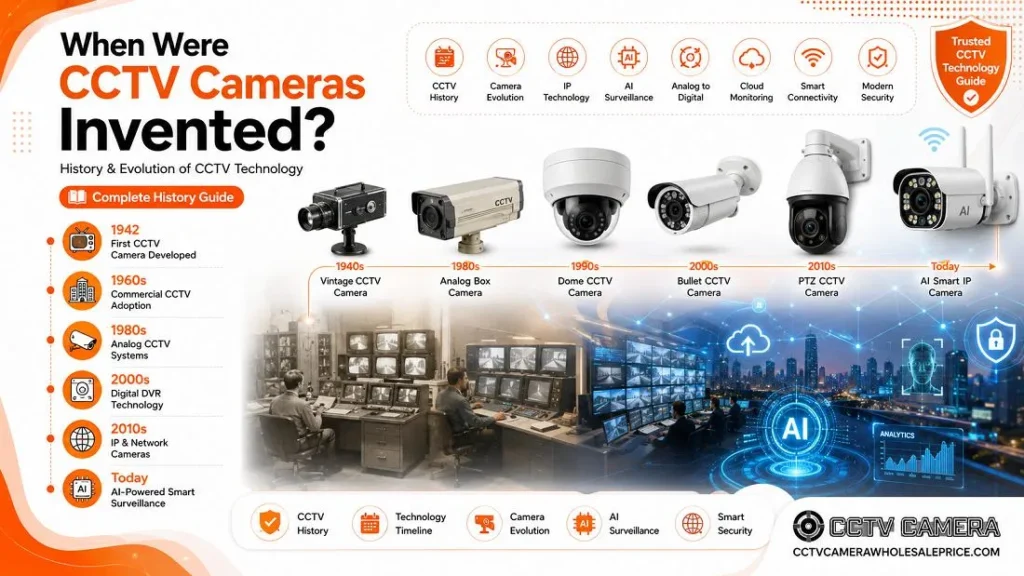
When Were CCTV Cameras Invented?
The First CCTV Camera Was Invented in 1942
Modern surveillance began in World War II, not to prevent crime, but to meet a military need. The first recorded use of a security camera system was in 1942, during World War II. German engineer Walter Bruch worked for Siemens AG. He invented a closed-circuit television (CCTV) technology. This revolutionary invention wasn’t created to capture criminals. It was a result of wartime innovations and security issues.
Why Was the First CCTV System Created?
This system was built for a specific military use. It was meant to watch V-2 rocket launches from far away. The launches happened in Peenemünde, Germany. Imagine being a scientist or military officer responsible for monitoring dangerous rocket tests. The German military did not want to put personnel at risk near launch sites.
They used cameras to watch launches from a bunker. The cameras could send live video to a set monitor, but there was a limit. They could not record. Operators had to watch everything in real-time or miss it entirely.
Who Invented CCTV Cameras?
Walter Bruch and the First CCTV System
Walter Bruch helped develop the PAL television system. He also built the first CCTV system. Working for Siemens AG, Bruch and his team built a simple but groundbreaking system.
A camera connected by cable to a monitor.
This setup created what we now call a “closed circuit.”
The video feed was not broadcast to the public.
It stayed between the camera and the chosen viewing area. This concept of “closed circuit” remains the foundation of all CCTV systems today.
How Early CCTV Technology Worked
The early CCTV was quite primitive in comparison to modern standards. The system relied on analog signals, which traveled on wires. There was no digital processing, no storage, or artificial intelligence. Monitors were monitored 24/7 by operators to detect any issues. It took a lot of work, needed constant human attention, and produced grainy black-and-white images. But even with these limitations, it was a success. It demonstrated that remote surveillance of video was feasible.
The Evolution of CCTV Cameras
1940s–1960s: Military Surveillance
Following the conflict, CCTV systems became available to commercial users in 1949. The system quickly became popular as a security tool that was advanced. Within the United States, it was made available as Vericon. However, the commercial use of Vericon was slow and costly. In 1960, the London Metropolitan Police set up two temporary cameras in Trafalgar Square. They spied on crowds waiting for an appearance by Thai royals. Thai Royal Family. This was the momentous turning point. Surveillance began to leave the military and enter civilian areas.
1970s–1990s: Commercial & Public Security
The game changed with two inventions. The first major improvement to modern CCTV systems came in 1973 with the charge-coupled device (CCD). CCDs made cameras smaller, more efficient, and affordable. Then came VCRs. Suddenly, banks and retail stores could record and review footage. They no longer needed constant live monitoring. In 1969, Marie Van Brittan Brown and her husband patented a new home security system. It had many peepholes, a sliding camera, a monitor, audio, and an electric door lock. Home security would never be the same.
2000s–Present: Digital, IP & AI CCTV Cameras
Remote video surveillance grew fast in 1996. Axis introduced the first network IP security cameras. They sent video as digitally encoded signals. They used Ethernet networks instead of analog signals. As computer technology grew in the mid-1990s, digital video recorders (DVRs) appeared. They recorded analog camera video directly to hard drives. By the 2000s, Network Video Recorders (NVRs) replaced DVRs. IP cameras then became the industry standard. Today, AI-powered CCTV systems offer facial recognition, real-time threat detection, and cloud integration. These features would have seemed like science fiction in 1942.
Key Milestones in CCTV Camera History
1942 – First CCTV Camera: Walter Bruch builds a system to monitor V-2 rocket tests.
1949 – Commercial CCTV Systems: Vericon brings surveillance to American businesses.
1969 – Home Security Cameras: Marie Van Brittan Brown patents a home CCTV system.
1973 – CCD Technology: Charge-coupled devices make cameras more efficient.
1996 IP Cameras and DVRs: Axis introduces the NetEye 200.
In the 2000s The NVR and the Network Integration cameras have become the standard for the industry.
2020s AI-powered Smart surveillance: facial recognition and LLM-based searches improve surveillance.
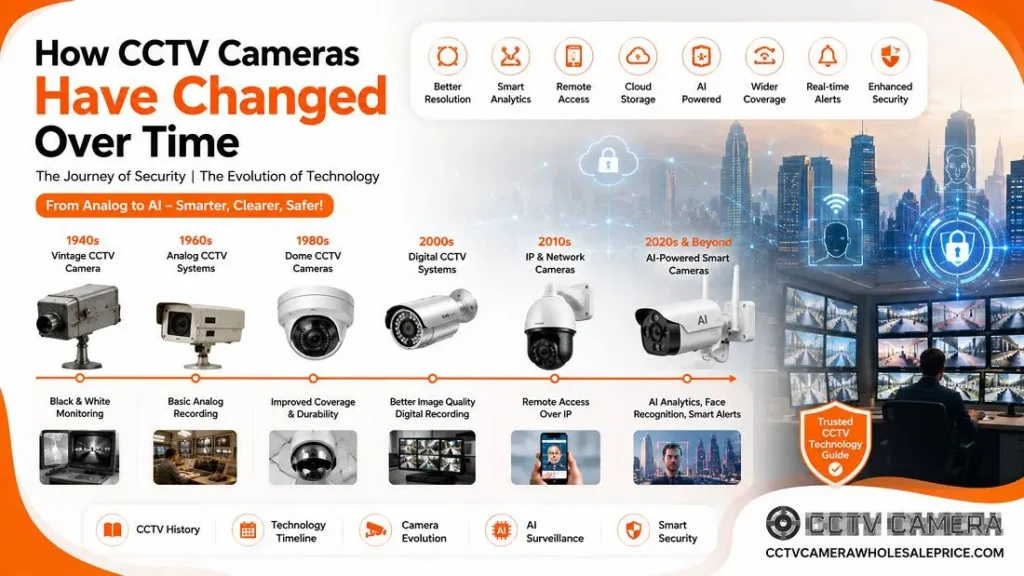
How CCTV Cameras Have Changed Over Time
Analog CCTV Cameras
Early cameras initially took black-and-white images. Later, they moved to color, which improved the quality and clarity of surveillance video. Analog systems were common from the 1940s to the 1990s. They required wiring connections as well as VCR recording and constant maintenance by hand. They were large with limited storage, and the image quality was poor. However, they were inexpensive and reliable.
Digital CCTV Cameras
DVRs can transform analog signals from cameras into digital ones. They saved the files to hard drives. This eliminated the requirement for large VCR tapes. This also enabled continuous recording, as well as more storage. Digital cameras changed surveillance by allowing more recordings, clearer images, and faster retrieval of footage. IP cameras were able to network, which allowed remote viewing from any part of the world.
Smart AI Surveillance Cameras
Nowadays, CCTV cameras are sophisticated systems that are not simply recorders. AI security cameras employ artificial intelligence to analyse events in real-time. They employ computer vision and trained models to analyze footage. They are able to recognize the presence of people, cars, packaging, pets, or license plates. Some can even recognize familiar faces. They reduce false alarms and detect threats in real time. They also integrate with cloud platforms for easy monitoring.
Why CCTV Cameras Are Important Today
Crime Prevention
CCTV systems serve as powerful deterrents to potential criminals. The mere presence of visible cameras reduces theft, vandalism, and criminal activity. When incidents happen, recorded footage provides key evidence for law enforcement and helps identify perpetrators.
Business & Home Security
Whether you protect a retail store, office, bank, or home, modern CCTV systems provide full monitoring 24/7. They track cash transactions, stop employee theft, protect inventory, and give homeowners peace of mind.
Remote Monitoring with Mobile Apps
One of the biggest advantages of modern IP and AI cameras is remote accessibility. Business owners and homeowners can watch their properties in real time using a phone, tablet, or computer. They can do this at work, on vacation, or anywhere in the world.
Frequently Asked Questions – When Were CCTV Cameras Invented?
When was the first CCTV camera invented?
The first recorded closed-circuit television (CCTV) system was invented in 1942 by German engineer Walter Bruch.
Who invented CCTV cameras?
Walter Bruch was a German engineer at Siemens AG.
In 1942, he developed the first CCTV system.
It was used to monitor V-2 rocket launches during World War II.
What was CCTV originally used for?
The first CCTV system served a military purpose. It let staff remotely watch V-2 rocket launches in Peenemünde, Germany.
When did CCTV become popular?
CCTV became popular in business in the late 1940s with Vericon. Widespread use came later, from the 1960s to the 1980s. During that time, technology got cheaper. VCRs also made recording possible.
What is the difference between analog and IP cameras?
Analog CCTV cameras transmit video signals through coaxial cables to DVRs. IP cameras send digital video over a network. This allows remote access, higher resolution, and easy links to cloud and AI systems.
Conclusion: The Journey from 1942 to AI-Powered CCTV Cameras
From military rocket launches to smart home security, CCTV has changed a lot over the past 80 years. What began as a simple camera and monitor system in 1942 has evolved. It is now an AI-powered network. It can do facial recognition and spot threats in real time. It can also use predictive analytics. Whether you own a business in Gurgaon, you may need full security. If you are a homeowner, you may want to protect your family. Modern CCTV systems can help. They offer strong safety, reliable coverage, and peace of mind.
Get Professional CCTV Solutions at Wholesale Prices
At CCTV Camera Wholesale Price, we offer modern security systems made for your needs. We provide advanced IP cameras, NVRs, and AI-powered smart surveillance solutions. With over ten years of industry experience, we help businesses and homeowners across India. We help you secure your property at a low cost.
📞 Call us today: 999 970 4813
✅ Best wholesale prices on CCTV cameras
✅ Expert installation & AMC services
✅ Brands: Hikvision, Dahua, CP Plus & more
✅ Fast delivery across Gurgaon & NCR
Don’t compromise on security—get professional CCTV solutions that fit your budget. Contact us for a free consultation and competitive quotes!